Products compliant with the CRA.

The cybersecurity of your IFOTEC equipment with the Cyber Resilience Act.

The security of connected products has now become a European priority. Cyber Resilience Act (CRA) is coming and already imposes high standards. Anticipating these requirements is a step further towards security. This article explains what the CRA is, but above all how our equipment already ensures cybersecurity in the most demanding infrastructures.

What is the Cyber Resilience Act?

Adopted in 2024 by the European Parliament, the Cyber Resilience Act (CRA) is a European regulation aimed at strengthening the cybersecurity of digital and connected products throughout their entire lifecycle.

Its main goal is clear: to reduce vulnerabilities and prevent cyber-attacks.

Manufacturers, importers and distributors of hardware or software electronic products marketed in the EU are all covered by this law.

From 2027 onwards, any product placed on the market in the European Union must be designed, developed and maintained with robust cybersecurity mechanisms in order to:

  • Integrate cybersecurity from the product development stage,
  • Guarantee secure authentication and access control,
  • Receive trustworthy updates,
  • Ensure equipment resilience and recovery,
  • Provide clear documentation on security features.

How do our products meet the CRA requirements?

At IFOTEC, cybersecurity is nothing new. Our industrial equipment is designed for critical environments (telecom networks, rail, tunnels, video surveillance) where security is non-negotiable. We integrated the principles of the CRA long before it came into force, in order to offer reliable and resilient solutions.

Our response to the CRA requirements

Our secure management interface, IFoS, embedded in our INet network switches, is the embodiment of our commitment. It includes features that already exceed CRA standards:

  • Secure updates: via authenticated firmware, ensuring the integrity of every update.
  • Strong authentication: support for RADIUS and TACACS+ for robust access control and precise traceability.
  • Encrypted communications: management of HTTPS certificates and customisable SSH keys securing remote administration.
  • Auditability: secure log export via SNMPv3 for proactive monitoring and anomaly detection.
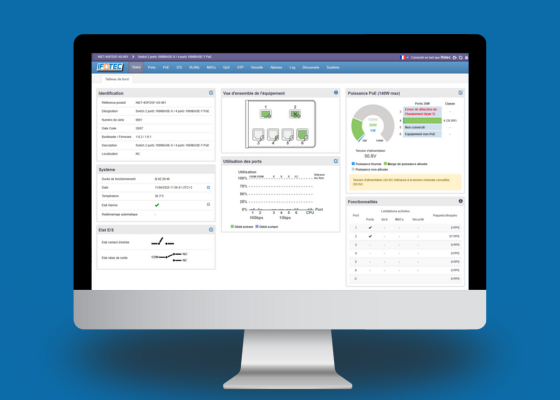
Our IFoS secure management interface

Solutions ready for your most demanding environments

Our anticipation of the CRA stems from a clear philosophy: designing reliable, robust and secure equipment—not out of obligation, but out of commitment to our customers. Whether for your telecommunications networks, critical video surveillance systems or industrial infrastructures, IFOTEC products offer integrated cybersecurity and proactive compliance.

Get ahead of the Cyber Resilience Act with IFOTEC

The CRA is an opportunity to collectively raise the level of digital security. With IFOTEC, you choose a partner who not only understands these challenges, but already provides solutions that meet them. Gain peace of mind, ensure the compliance of your infrastructures and reinforce digital trust with equipment designed for the future.

Don’t wait, discover our CRA compliant INet solutions.

Wonderful festive season

Wonderful festive season

We wish you a wonderful festive season!

Please be informed that IFOTEC will be closed from Thursday, 25th December 2025, to Friday, 02nd January 2026, inclusive. This festive break will allow our team to fully enjoy this special time with their loved ones.

We will be back on Monday, 5th January 2026, ready to support your projects with the same energy. Production, however, will resume from 8th January 2026.

During this period, please feel free to visit our website to learn more about our innovative products and solutions.

Have a wonderful festive season!

See all our news on LinkedIn!

INet4+ PoE switch in the Czech Republic

The INet4+ PoE switch modernises an urban network in the Czech Republic

As urban communication infrastructures evolve, the transition to a fibre-optic network requires reliable solutions. In the Czech Republic, the municipality of Nové Město na Moravě chose to install our INet4+ PoE switch with the aim of modernising its urban camera infrastructure. Discover the reasons behind this choice.

In search of a compact and secure PoE solution

To meet new access requirements, the municipal project manager was looking for a compact and versatile solution equipped with all the essential features for operating the infrastructure, such as:

  • Optical uplink
  • PoE (Power over Ethernet) supply for cameras
  • SNMP supervision
  • Advanced network management
  • Multiple VLANs for enhanced traffic isolation and security

The INet4+ PoE switch: IFOTEC’s perfect answer

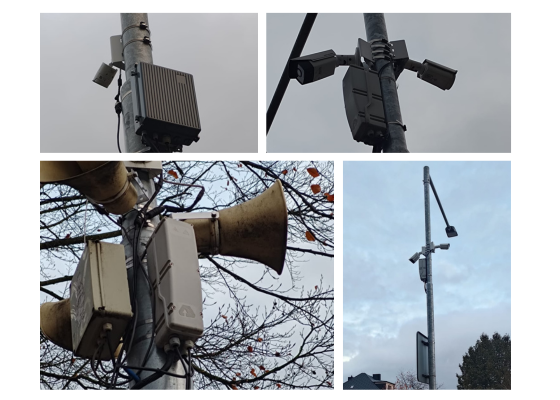
To meet the expectations of our Czech client, IFOTEC proposed the INet4+, a four-port, manageable Gigabit Ethernet PoE+ switch. Compact and robust, this switch is specifically designed for outdoor installation. It also stands out thanks to its seamless integration into a small enclosure mounted on a public lighting pole.

In addition, the INet4+ PoE switch enables our client to connect PoE cameras, provide public Wi-Fi, or establish reliable point-to-point links. Thanks to its secure IFoS management interface, our client benefits from simplified and secure management of their entire network.

Results and customer satisfaction

Today, our client is 100% satisfied with our INet4+ solution, which they consider robust against vandalism attempts as well as adverse weather conditions. It also offers excellent product integration within the urban landscape. Feeling confident, the client later reached out directly to our team for assistance in checking the firmware update.

Our ability to respond to each specific requirement highlights our responsiveness and our commitment to customer satisfaction at every stage of the relationship.

See INet4+ in action

Through these photos, discover how the INet4+ PoE switch is deployed in various urban settings to optimise fibre-optic networks.

For more information about the INet4+ switch or for any enquiries, please feel free to contact Samuel Atahias.

Electromagnetic Compatibility (EMC)

The development of electronic products must never be at the expense of compliance and reliability. This is why, as a French manufacturer, our responsibility is to ensure that our equipment operates without disrupting its environment and without being disrupted itself. This is where Electromagnetic Compatibility (EMC) truly comes into its own.

What is Electromagnetic Compatibility (EMC)?

EMC ensures that equipment coexists in the same electromagnetic environment.

Indeed, electronics are not perfect. Each component can emit disturbances. Therefore, any material containing electronics can disrupt or be disrupted.

EMC tests verify that equipment complies with current standards before it can be affixed with the CE marking and issued a declaration of EU conformity.

CE marking and the EMC Directive

To sell a product on the European market, it must meet strict specifications determined by notified bodies. Thus, the EMC Directive is one of the main requirements to be met to obtain the CE marking.

Compliance with the EMC Directive is certified in two ways:

  • By a certified body that issues a certificate after testing.
  • By self-certification, where the company declares the product’s conformity based on the results of tests performed.

For our IFOTEC products, we use several electromagnetic compatibility testing laboratories (including Esynov), which provide us with test reports on the basis of which we self-certify.

Electromagnetic Compatibility (EMC) tests

Emission and immunity

During laboratory tests, we distinguish two major phases:

  • Emission tests: These measure the electromagnetic “pollution” that equipment emits, either by conduction (via the electrical network) or by radiation (electromagnetic waves).
  • Immunity (or susceptibility) tests: These evaluate the equipment’s ability to withstand external disturbances without performance degradation, such as electrostatic discharges, surge waves, or radiated fields.

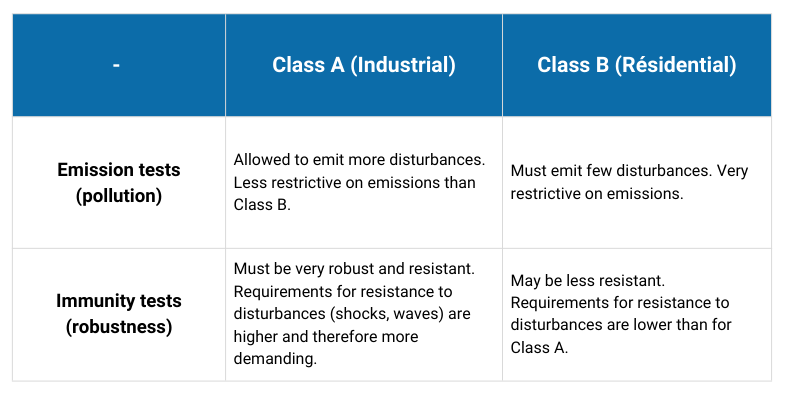
Residential (Class B) or Industrial (Class A) environment?

The level of testing requirements is defined by the product’s final environment.

Fundamental standards and generic standards

To ensure complete qualification, we combine the application of two types of standards.
We use specific fundamental standards for each type of test, such as the IEC 61000-4 series for immunity (e.g., IEC 61000-4-2 for ESD) and standard 55032 for emission measurements.

In addition, we also use generic standards, as our products do not target a specific market (such as railway EN 50121-4 or aeronautical DO-160). They determine performance and requirement thresholds based on the environment:

  • 61000-6-1: Immunity for residential environments
  • 61000-6-2: Immunity for industrial environments
  • 61000-6-3: Emission standard for residential environments
  • 61000-6-4: Emission standard for industrial environments

However, some of our equipment may comply with other standards while having passed 61000-6-2 and 61000-6-4 tests. For example, our new Gigabit media converters benefit from additional qualification: alarm systems standard EN 50130-4 and railway standard EN 50121-4.

EMC qualification of our INET10X++ switch

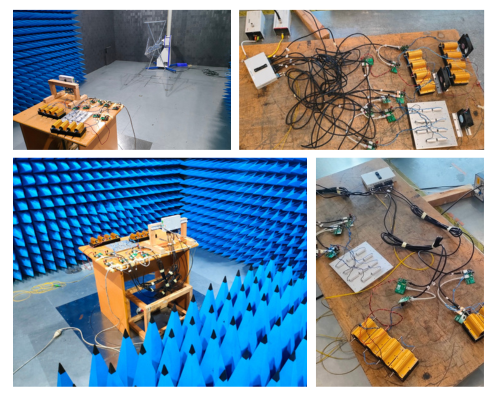
As part of the certification of our new manageable 10 Gigabit Ethernet PoE++ switch INet10X++ intended for industrial use, we conducted a series of rigorous tests at the ESYNOV laboratory.

On the left: Immunity and radiated emission test in an anechoic chamber.
On the right: Conducted emission test on the INet10X++.

Our INet10X++ Ethernet switch aimed for industrial standards IEC 61000-6-2 (Immunity) and IEC 61000-6-4 (Emission). Consequently, it complies with all regulatory requirements of Class A, including conducted emission and lightning surges. Thus, we can affirm its reliability in demanding industrial environments.

A guarantee of reliability thanks to EMC tests

Electromagnetic Compatibility is not merely an administrative step, but a critical engineering discipline. It therefore guarantees the reliability, safety, and conformity of equipment.

At IFOTEC, we see EMC as far more than a simple administrative step at the end of a project. We anticipate it from the very beginning of the development cycle. Our approach is proactive:

  • We consider the impact of components and apply strict design rules during PCB routing to minimise phenomena that could be disastrous in testing.
  • Unlike some structures that separate design and validation, our engineers within our electronic design office are involved upstream and understand the impact of their choices, ensuring a prepared and effective approach.

This proactive approach allows us to subject our equipment to extremely rigorous EMC tests, often exceeding minimal requirements. This level of expertise ensures the quality and performance of our equipment for all environments (residential or industrial).

Learn more about Esynov.